Categories
Uncategorized

Time crystal

Time Crystals: A New Form of Matter That Could Change Everything
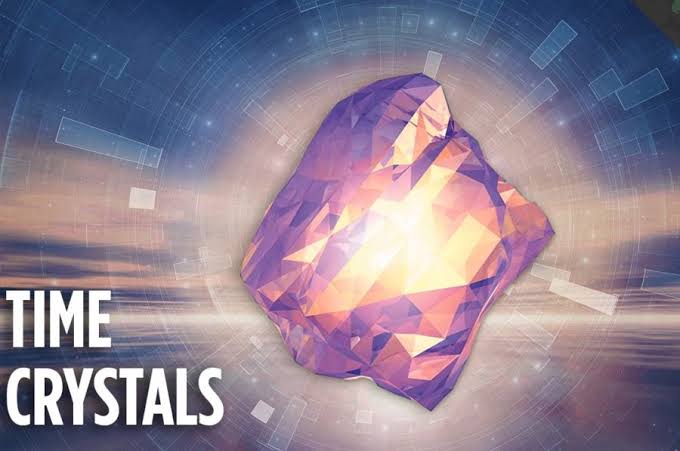
Of all the science-fiction-sounding names that have come to fruition in recent years, perhaps none is as mysterious or seemingly fictitious as time crystals. The name evokes something between Back to the Future and Donnie Darko, and the reality is perhaps crazier than either.

Two separate groups of scientists recently reported they observed time crystals, which lends credence to the idea that this theoretical state of matter is something humans can actually create and observe. And indeed, time crystals can be grown in a child’s bedroom.

But, it requires nuclear sensors and lasers to help time crystals reach their full potential and then measure and observe them. This combination of dramatic scientific terms and shockingly simple objects is a great analogy for time crystals as a whole.

Read on to understand what they are and how they might affect our lives.

What Are Time Crystals?

What Are Time Crystals

Time crystals are systems of atoms that arrange themselves in time the way more traditional solids crystallize in space. In case your brain isn’t bent enough trying to figure out what that means, the two groups of scientists created radically different structures that both fall under the label “time crystals.”

These atomic arrangements are not time travel portals or infinite Rube Goldberg Machines, but rather the advent of a whole new state of matter–independent from the familiar solids, liquids, and gases that comprise our known universe.

MIT theoretical physicist Frank Wilczek first proposed the idea of time crystals in 2012, positing that if properties change over time rather than in space that it might create new states of matter. Less than six years later, the two groups of scientists created crystals that seem to possess properties similar to those he proposed.

Seriously, What Does This Mean?

Physical laws revolve around symmetries, which are moments where an action creates an equal reaction, regardless of the environment. This is basic Newtonian Physics, and one of the foundational laws of how we perceive the universe. A burning log creates a measurable amount of heat based on the amount of available mass, a ball hitting a wall bounces off the wall with the same force it hit it with–minus losses to dissipation, which could be measured in heat.

Wilczek wondered if molecules could break traditional time translated symmetry, which  is what regulates the laws responsible for creating crystals. Traditional crystals like salt and quartz are three-dimensional, ordered spatial crystals. Their atoms are arranged in a predictable, repeating system.

Time crystals, on the other hand, are different at the atomic level. Their atoms spin periodically, changing directions as some pulsating force flips them. Quite literally, time crystals “tick” like an old grandfather clock, and their atoms flip at a constant, periodic frequency.

But that’s not why they have the name time crystal–the name comes from the fact the crystals’ atomic structure repeats in time, which is why they seem to oscillate at set frequencies. Time crystals never find equilibrium the way that a diamond or ruby does, so they are now considered one of the few examples of non-equilibrium matter known to scientists.

Time Crystals in the Real World
You are probably wondering what time crystals look like, whether you’d know one if you saw it, and what exactly they are going to do for us. The most important thing to understand is that time crystals are fundamentally only existent in limited laboratory circumstances, particularly when given a nudge by scientists to set their oscillation into motion.

Once oscillating, it appears time crystals will reverberate indefinitely. And the Harvard group’s experiment produced a crystal that, once activated, glowed as a result of its periodic energy reverberations.

The Yale team that discovered time crystals found them within a surprising set of matter– monoammonium phosphate (MAP) crystals. These are remarkably easy crystals to grow, and they’re often included in children’s grow-your-own crystal sets.

A student had MAP crystals in the lab for a different experiment when the time crystal team decided to look for the signature of a discrete time crystal using nuclear magnetic resonance. Yale Research scientist Sean Barrett summarized wryly, “Our work suggests the signature of a DTC could be found, in principle, by looking in a children’s crystal growing kit.”

This discovery of time crystals in a simple and wildly unexpected place raises fundamental questions about how time crystals form and what states of matter might exist in time within existing observed matter in space. The breadth and richness of phases of matter in the universe is, apparently, even greater than we previously understood.

And these phases, which may not be observable with the traditional five senses but are shockingly apparent when measured using tools that can perceive atomic oscillations, could be far more common than Wilczek ever imagined when he first proposed his theory.

By adding laser or microwave pulses to seemingly-solid objects, we may well discover these constant oscillations in atomic matter throughout the universe, and some forms of time crystal could easily be more dramatic than those that have been observed thus far.

Future Applications

Scientists believe understanding time crystals and refining our understanding of them will allow breakthroughs in the power and accuracy of atomic clocks, gyroscopes, and magnetometers, as well as further developing how we build potential quantum technologies.

The promise of using stable quantum systems at far higher operating temperatures than what we can currently achieve might be the final push needed to make quantum computing a reality–which is a really big deal. The U.S. Department of Defense announced a funding program to investigate more potential applications of time crystals, as quantum computing is one of the most promising technological horizons in the computer age.

The discovery of time crystals also requires re-evaluation of some existing theories and understandings as it seems to suggest there are phases of matter beyond the realm of what we currently understand. There are some potential applications of time crystals that are even more sci-fi than their name implies, but unlike many such futuristic-sounding breakthroughs, time crystals already exist in more than one form and have been confirmed in peer-reviewed studies by multiple university research teams.

Conclusion

Yes, time crystals sound like something straight out of a science fiction model. But the more we come to understand how they work, the more we’re beginning to understand just how much potential they have.

As we start to bump up against limitations in how many transistors can be physically included in a microchip, time crystals may be the solution that opens up radically new methods of computing.

What’s clear is that the more we look into the “crystal ball” of time crystals, the future is promising.

Categories
Uncategorized

UK Storm(ferocious storm heads towards UK).

UK weather latest: Heatwave GONE as ferocious storm heads towards UK – Maps and charts

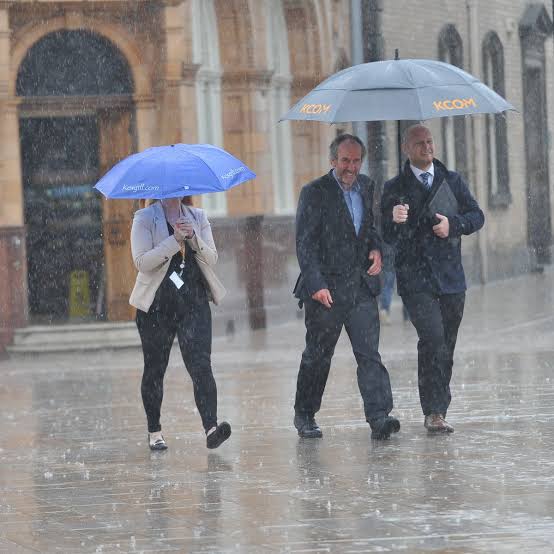
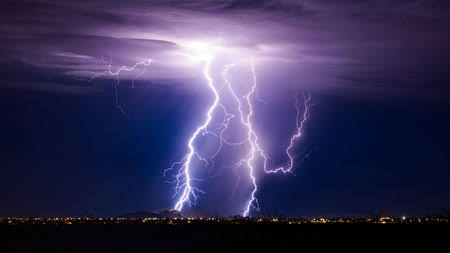
THE UK has been hit by severe thunderstorms and heavy rain this weekend as the heatwave came to and end, and new weather maps are now showing a ferocious storm heading towards Britain.

Thunderstorms, lightning and heavy rain have hit parts of the UK this weekend. As a result, the Met Office has issued several severe weather warnings for most of England and Wales until Monday evening. The weather agency has warned the heavy showers may lead to some flooding or travel disruption. The Met Office wrote in its warning: “Some heavy showers and thunderstorms are expected overnight, with further thunderstorms then developing across many areas of England and Wales during the late morning and afternoon, when they are likely to be slow moving.

The storm will bring thunder and hailstones to the country throughout the week

A cluster of storms, formed off the East Coast of the US, is heading to the UK, confirming the end of last week’s heatwave as it adds to the heavy rain seen in recent days.

The aftermath of Storm Kyle has caused the Met Office to issue a number of weather warnings across the UK, with the worst-hit places expected to be Wales. According to weather reports, the storm is “extra tropical”, and the UK will feel its force when it joins up with another storm heading from Greenland.

How bad will it be?

The remnants of Storm Kyle will impact the UK from late on Monday afternoon, bringing 55mph winds. The Met Office warns some heavy showers and thunderstorms will develop across many areas of England and Wales throughout the afternoon, with rain, wind, thunder and hailstones  expected.

The Met Office’s warnings are in place until 9pm Monday for the East Midlands, East of England, London and South East England, North East England, North West England, South West England, Wales, the West Midlands and Yorkshire and Humber. It looks likely that Scotland will avoid most of the bad weather.

Some places within the warning area will miss the thunderstorms altogether, but where they do occur 20 to 40mm of rain may fall within an hour, with 50 to 70mm possible in three or four hours.null

“Pop up thunderstorms in summer are some of the trickiest weather to pin down to a specific location – with some places experiencing flooding and others staying dry”, the Met Office tweeted.

The last of several yellow severe weather warnings for storms affecting large parts of Britain will come to an end at 9pm. Flood warnings will remain in place. Temperatures are expected to range from 17 degrees to 25 degrees Celsius, despite the blustery showers.Ponchos and raincoats might be in order as the UK is battered by storms throughout the week (Photo: Aaron Chown/PA)

What caused the storm?

Storm Kyle formed off the US East Coast over the weekend, and remnants of it are heading across the North Atlantic, merging with another storm that is coming from Greenland. The combination will cause severe weather conditions.

Storm Kyle is the 11th named storm of the 2020 Atlantic Hurricane Season and will go down in the record books as the earliest “K” storm. Despite the weather it will unleash on the UK, the storm did not devastate the States, as it started heading out across the North Atlantic ocean shortly after forming, missing the land.

When will the weather start to clear up?

Tuesday will see the weather start to get a bit drier, although some showers can still be expected.null

But bad weather is forecast for the rest of the week: “Some isolated thunderstorms are possible, though these will not be as severe as recent days,” the Met Office said.

Categories
Uncategorized

Can we craft a theory in which space and time aren’t assumed to exist?

Can we craft a theory in which space and time aren’t assumed to exist?


While quantum mechanics deals with reality in discrete, granular fashion, relativity tells us that space-time, and therefore gravity, is continuous and non-discrete. The mathematics produced myriad discrete geometric objects, including loops, lattices, and polygons, arranged in various constructions called spin-networks and spin foams. Their simultaneous existence generates a paradox, meaning physics is, in a sense, in disarray. Oriti told Ars that, at that time, emerging ideas about black holes focused on using quantum mechanics to describe the matter fields around them. New approaches to quantum gravity, like LQG, began to emerge during this period. In LQG we call these basic entities spin-networks, which are discrete, algebraic objects. Since we know the world is quantum, general relativity must be an approximation of an underlying quantum description of space-time itself.

Over the past decades, a field of physics has developed that postulates the existence of mysterious algebraic entities called spin networks. These networks—proposed as the constituent stuff of space and time—condensed to produce the Universe as we know it. That condensation resulted in the event that we currently call the Big Bang, giving the field its name: condensate cosmology.

The idea, technically termed “Group Field Theory (GFT) condensate cosmology,” is a branch of quantum gravity, a field of physics that aims to establish the fundamentals of what everything from light and matter to space and time is made of. It is an idea based completely in theoretical calculations—and it’s totally untested for now. Condensate cosmology requires a great deal of abstract reasoning to even try to understand it. 

Despite these challenges, quantum gravity has drawn a lot of attention from some of the sharpest minds in all of physics. Its ideas are bold and daring, highly creative, and extraordinarily imaginative. 

Categories
Uncategorized

Einstein was right (recent research 2020)

Einstein was right about how extremely massive objects fall in space

SPACE

The motion of stars has helped prove Einstein correct again

Even in some of the most extreme areas in the universe, Albert Einstein’s theory of general relativity seems to hold up. A test of a key tenet of general relativity using three stars has shown that all objects fall with the same acceleration regardless of their composition.

This fits with a cornerstone of Einstein’s theory known as the strong equivalence principle. It states that any two objects in the same gravitational field fall with the same acceleration regardless of their mass or their make-up. This was famously shown by Galileo’s apocryphal test, in which he is said to have dropped two spheres of different masses off the Leaning Tower of Pisa and found that they hit the ground at the same time.

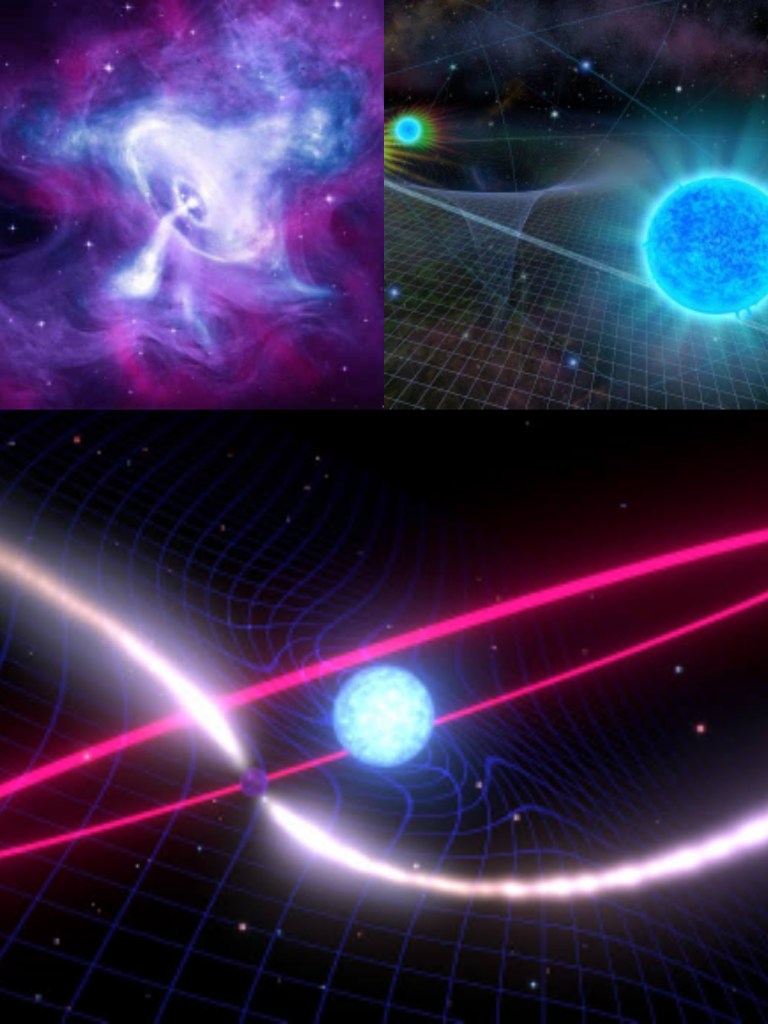
Guillaume Voisin at the University of Manchester in the UK and his colleagues tested this principle by measuring the movement of a white dwarf star and a pulsar – a type of fast-spinning neutron star – orbiting around a second white dwarf. “It’s basically Galileo dropping things from the Tower of Pisa, but on a much more massive scale,” says Voisin. “It’s a test that two objects are reacting in the same way to the third one.”

This test came with a twist: under some formulations of gravity, but not general relativity, a pulsar would be expected to behave differently to other stars, planets, or even balls dropped from a tower in Italy because pulsars are so much more massive and compact.

The researchers found that the pulsar and white dwarf orbited exactly the same as one another in the highest precision test of the equivalence principle performed with such massive objects. “It’s about 1000 times better than anything that was done with neutron stars before,” says Voisin.

“The only theory of gravity that strictly follows the equivalence principle is general relativity – every other hypothesis breaks it at some level,” he says. Once again, Einstein’s general relativity has stood the test of time and gravity.

Categories
Uncategorized

The last event of Universe

MenuShow SearchSPACE

Black dwarf supernovae might be the last event in the universe

The universe may have started with a Big Bang, but it will most likely end in an utterly anticlimactic way, slowly fading to black over trillions and trillions of years. Now, a theoretical physicist at Illinois State University has calculated what might just be the last interesting event that will ever happen – the explosions of stars called black dwarfs, which don’t even exist yet.

The ultimate fate of the universe is still up for debate, but one of the leading hypotheses is that it will undergo a “heat death.” Basically, all the stars will cool down and fizzle out, black holes will evaporate, and the never-ending expansion of the universe will stretch the fabric of reality so far that the remaining subatomic particles will rarely have the chance to whiz within a parsec of each other.


And now, thanks to theoretical physicist Matt Caplan, we have an idea of what might be one of the last things that will ever happen – black dwarf supernovae.

Currently, supernovae are explosive finales that are reserved for massive stars. When these huge thermonuclear reactors run out of fuel, the core will collapse and trigger a supernova, leaving behind a black hole or neutron star.null

Smaller stars, such as our Sun, will instead expand into red giants then eventually shrink back down into white dwarfs. Since these white dwarfs don’t (normally) have the mass to go supernova themselves, they instead slowly cool down to the background temperature of space. When that happens, they’ll fade out and “freeze solid”, becoming cold, dark black dwarf stars.

It’s been calculated that this process would take trillions of years, and since the universe itself is “only” 13.4 billion years old, scientists don’t expect any black dwarfs to exist yet. The oldest known white dwarfs are still shining brightly.

A black dwarf was basically thought to be the end of the story, but according to Caplan, there’s still some life to be found in these objects. Fusion can still occur at very cold temperatures – it just takes an incredibly long time and requires some help from quantum mechanics.null

The phenomenon of quantum tunneling means that occasionally, a particle will be able to “tunnel” through a barrier that normally it wouldn’t have enough energy to overcome. In this case, nuclei inside a black dwarf could spontaneously fuse together, even though they “shouldn’t” have enough energy to do so.

Eventually, those fusion products should build up enough to choke the black dwarf into a supernova, in a similar way to more massive stars. This explosive fate awaits as many as one percent of all stars shining today, Caplan estimates, while the vast majority will plod along silently as black dwarfs forever.

“Only the most massive black dwarfs, about 1.2 to 1.4 times the mass of the Sun, will blow,” says Caplan. “Even with very slow nuclear reactions, our Sun still doesn’t have enough mass to ever explode in a supernova, even in the far far future.”null

The physicist says that the most massive black dwarfs will be the first to go, followed by less and less massive ones within that range. But maybe hold off on whipping out your telescope to try to see one – you’ll be waiting an incomprehensibly long time. Caplan calculates that the first black dwarf supernova won’t happen for about 101,100 years. That’s a one followed by 1,100 zeroes, a number so big we don’t have a word for it.

“In years, it’s like saying the word ‘trillion’ almost a hundred times,” says Caplan. “If you wrote it out, it would take up most of a page. It’s mindbogglingly far in the future.”

And even if you could stick around to witness these events from the safety of a time machine, chances are slim that you would even be able to find them in the impossibly inky blackness of the universe’s Dark Era.null

“Galaxies will have dispersed, black holes will have evaporated, and the expansion of the universe will have pulled all remaining objects so far apart that none will ever see any of the others explode,” says Caplan. “It won’t even be physically possible for light to travel that far.”

But these black dwarf supernovae will still fire away, like trees falling in the woods with no one around, for an amount of time that’s even harder to fathom. Caplan says that the final black dwarf to go supernova will do so around 1032,000 years in the future.

“It’s hard to imagine anything coming after that,” says Caplan. “Black dwarf supernova might be the last interesting thing to happen in the universe. They may be the last supernova ever.

Time and space contrast

Spacetime is a real substance undergoing changes but which exists independently of those processes occurring within spacetime. Indeed, spacetime substantivalism constitutes a serious threat to the claim that space and time are abstracts because it considers spacetime points as concrete particulars.

Categories
Uncategorized

Largest Impact of Structure In The Solar System.

Largest Impact Structure In The Solar System Might Be On Jupiter’s Ganymede

The darker terrain on Ganymede in this artist’s impression is the location of the possible ancient crater. Tsunehiko Kato, 4D2U Project, NAOJ

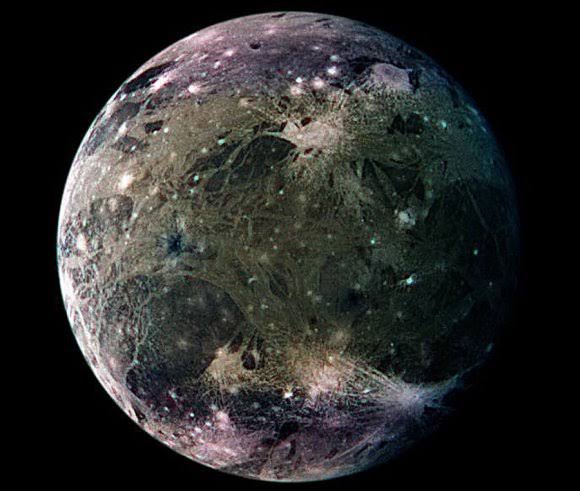
Astronomers believe they have identified the largest impact structure in the Solar System. By combining previous observations, scientists from Japan found that the Jovian moon Ganymede experienced a catastrophic impact event in the past.

The evidence for this is a series of ancients troughs on the surface of the moon. These geological formations are distributed concentrically across most of Ganymede. For the scientists, this is proof they were created by a single massive impact. The research is published in the journal Icarus.nullADVERTISINGnull

The troughs are present on about 35 percent of the moon’s surface, which implies the impact crater has a radius of up to 7,800 kilometers (4,800 miles). The team estimates the body that created it would have been at least 50 kilometers (30 miles) wide, but more likely it was three times more. Sw

Ganymede was recently studied by the Juno mission currently orbiting Jupiter, but detailed images of the moon’s surface are decades older. They were obtained by NASA’s Voyager 1, Voyager 2, and Galileo spacecraft. Researchers can’t be certain that the bullseye-like structure was created by an impact. However, it might be possible to find out by early next decade. At the end of the 2020s, we are going back to Jupiter to gain in-depth observations of the major Jovian moons.

“The European Space Agency’s JUICE (Jupiter Icy Moon Explorer) mission, scheduled to launch in 2022 and arrive in 2029, will examine Jupiter and its moons, including Ganymede, with instruments such as the GAnymede Laser Altimeter (GALA) which NAOJ is helping to develop and imaging spectrographs,” lead researcher Naoyuki Hirata comments said in a statement.

“GALA is being developed mainly by the German Aerospace Center in collaboration with institutes in Switzerland, Spain, and Japan, including JAXA, Chiba Institute of Technology, Osaka University, and NAOJ. We hope that JUICE will confirm the results of this study and further advance our understanding of the formation and evolution of Jupiter’s moons.”

Ganymede is not only the largest moon of Jupiter but also the largest of all known moons. It is bigger than the planet Mercury, making it the 9th largest object in the Solar System.

Categories
Uncategorized

AI

Artificial Intelligence (AI)

What Is Artificial Intelligence (AI)?

Artificial intelligence (AI) refers to the simulation of human intelligence in machines that are programmed to think like humans and mimic their actions. The term may also be applied to any machine that exhibits traits associated with a human mind such as learning and problem-solving.

The ideal characteristic of artificial intelligence is its ability to rationalize and take actions that have the best chance of achieving a specific goal.null

Understanding Artificial Intelligence

When most people hear the term artificial intelligence, the first thing they usually think of is robots. That’s because big-budget films and novels weave stories about human-like machines that wreak havoc on Earth. But nothing could be further from the truth.

Artificial intelligence is based on the principle that human intelligence can be defined in a way that a machine can easily mimic it and execute tasks, from the most simple to those that are even more complex. The goals of artificial intelligence include learning, reasoning, and perception.

As technology advances, previous benchmarks that defined artificial intelligence become outdated. For example, machines that calculate basic functions or recognize text through optimal character recognition are no longer considered to embody artificial intelligence, since this function is now taken for granted as an inherent computer function.null

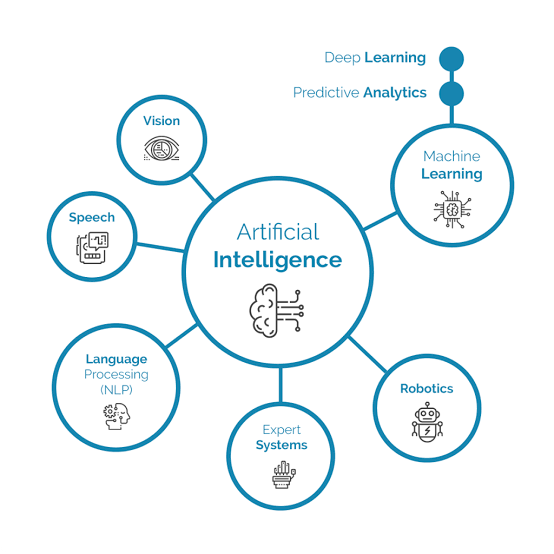
AI is continuously evolving to benefit many different industries. Machines are wired using a cross-disciplinary approach based in mathematics, computer science, linguistics, psychology, and more.

Algorithms often play a very important part in the structure of artificial intelligence, where simple algorithms are used in simple applications, while more complex ones help frame strong artificial intelligence.

Applications of Artificial Intelligence

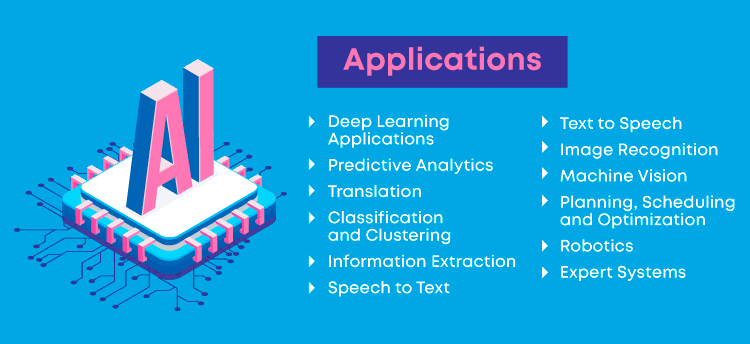
The applications for artificial intelligence are endless. The technology can be applied to many different sectors and industries. AI is being tested and used in the healthcare industry for dosing drugs and different treatment in patients, and for surgical procedures in the operating room.null

Other examples of machines with artificial intelligence include computers that play chess and self-driving cars. Each of these machines must weigh the consequences of any action they take, as each action will impact the end result. In chess, the end result is winning the game. For self-driving cars, the computer system must account for all external data and compute it to act in a way that prevents a collision.

Artificial intelligence also has applications in the financial industry, where it is used to detect and flag activity in banking and finance such as unusual debit card usage and large account deposits—all of which help a bank’s fraud department. Applications for AI are also being used to help streamline and make trading easier. This is done by making supply, demand, and pricing of securities easier to estimate.

KEY TAKEAWAYS

  • Artificial intelligence refers to the simulation of human intelligence in machines.
  • The goals of artificial intelligence include learning, reasoning, and perception.
  • AI is being used across different industries including finance and healthcare.
  • Weak AI tends to be simple and single-task oriented, while strong AI carries on tasks that are more complex and human-like.

Categorization of Artificial Intelligence

Artificial intelligence can be divided into two different categories: weak and strong. Weak artificial intelligence embodies a system designed to carry out one particular job. Weak AI systems include video games such as the chess example from above and personal assistants such as Amazon’s Alexa and Apple’s Siri. You ask the assistant a question, it answers it for you.

Strong artificial intelligence systems are systems that carry on the tasks considered to be human-like. These tend to be more complex and complicated systems. They are programmed to handle situations in which they may be required to problem solve without having a person intervene. These kinds of systems can be found in applications like self-driving cars or in hospital operating rooms.

Special Considerations

Since its beginning, artificial intelligence has come under scrutiny from scientists and the public alike. One common theme is the idea that machines will become so highly developed that humans will not be able to keep up and they will take off on their own, redesigning themselves at an exponential rate.

Another is that machines can hack into people’s privacy and even be weaponized. Other arguments debate the ethics of artificial intelligence and whether intelligent systems such as robots should be treated with the same rights as humans.null

Self-driving cars have been fairly controversial as their machines tend to be designed for the lowest possible risk and the least casualties. If presented with a scenario of colliding with one person or another at the same time, these cars would calculate the option that would cause the least amount of damage.

Another contentious issue many people have with artificial intelligence is how it may affect human employment. With many industries looking to automate certain jobs through the use of intelligent machinery, there is a concern that people would be pushed out of the workforce. Self-driving cars may remove the need for taxis and car-share programs, while manufacturers may easily replace human labor with machines, making people’s skills more obsolete.

Weak AIWeak AI is a machine intelligence that is limited to a particular area. moreStrong AIStrong AI is a type of machine intelligence that is equivalent to human intelligence. moreWhat Is Knowledge Engineering?Knowledge engineering is a field of artificial intelligence (AI) that enables a system or machine to mimic the thought process of a human expert. moreIntroduction to Natural Language Processing (NLP)Natural Language Processing (NLP) is a type of artificial intelligence that allows computers to break down and process human language. moreArtificial Neural Network (ANN)An artificial neural network (ANN) is the foundation of artificial intelligence (AI), solving problems that would be nearly impossible by humans. moreRobotic Process Automation—RPA DefinitionRobotic process automation (RPA) refers to software that can be easily programmed to do basic tasks across applications just as human workers do.

Design a site like this with WordPress.com
Get started